
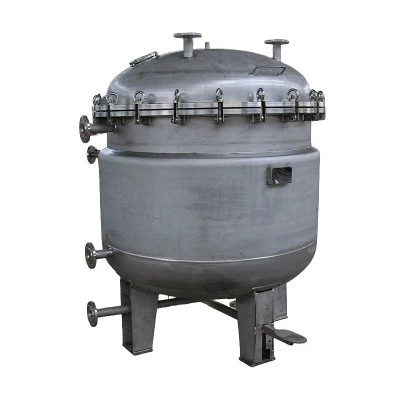

Wound PPH Reaction Tank
- Suitable for stirring and reaction under atmospheric pressure or slight positive pressure
- Agitator options include stirring paddles, dispersion plates, and emulsifying heads
- Optional heating or cooling coils for temperature-controlled reactions
- General operating temperature range of -10°C to 120°C, depending on the equipment configuration
- Suitable for corrosive materials that must not come into contact with metal
|
Parameter |
Details |
|
Corrosion and temperature resistance |
Performance comparable to PTFE, as specified; suitable for most acids, alkalis, salts, and other compatible chemical media. The general operating temperature range is -10°C to 120°C, while some equipment is rated for -10°C to 90°C |
|
Structural composition |
Tank body and cover, upper and lower heads, agitator (stirring paddle, dispersion plate, or emulsifying head), drive unit, shaft sealing device, and support. Heating or cooling coils are optional |
|
Working principle |
A motor drives the shaft and blades to generate shear, convection, and centrifugal forces for mixing, reaction, or dissolution. Heating or cooling media circulate through the coils to maintain the required temperature. Depending on the design, reactions can be carried out under atmospheric pressure or negative pressure. Material is discharged through the bottom outlet |
|
Applications |
Pharmaceutical, chemical, petroleum, metallurgy, electroplating, environmental protection, dyeing, new energy battery, and food industries. Particularly suitable for corrosive materials that must not contact metal |
The tank body is formed in one piece by winding PPH pellets, eliminating seams in the tank shell. This construction reduces potential leakage points associated with joints. The winding process also provides structural strength, while the welds used for connected components must meet the applicable requirements for the base material and operating conditions.
PPH is lightweight, corrosion-resistant, and easy to transport, install, and clean. Its suitability for food-related applications depends on the material grade and applicable hygiene requirements. The agitator can be fitted with a stirring paddle, dispersion plate, or emulsifying head, depending on the required mixing effect. Heating or cooling coils can also be added to meet specific process requirements.
The Wound PPH Reaction Tank uses a motor-driven shaft and blades to generate shear, convection, and centrifugal forces for mixing, reaction, or dissolution. Hot water, a refrigerant, or hot oil can circulate through the coils for heating or cooling, depending on the equipment design and process requirements. The reaction pressure depends on the selected configuration and may be atmospheric or negative pressure where the tank is designed for that service. After the reaction and any required evaporation or reflux process, the material is discharged through the bottom outlet.
This equipment is intended for processes involving corrosive materials that cannot come into contact with metal. Applications include pharmaceutical and chemical production, petroleum processing, metallurgy, electroplating, environmental protection, dyeing, new energy battery manufacturing, and food processing.
The company has experience supplying reaction equipment for dyeing plants and new energy battery plants. Each tank is customized according to the reaction medium, operating temperature, required stirring method and speed, and heating or cooling requirements.
The manufacturing process includes inspecting the PPH raw material, carrying out spiral winding, assembling the tank and its components, and completing commissioning. The agitator, shaft seal, coil arrangement, and other components are selected according to the process conditions and installation requirements.
Quality checks include weld inspection, water-fill leak testing, stirring shaft runout measurement, and no-load and loaded trial runs. Third-party inspection is accepted. The warranty period is one year.
The standard lead time is approximately two months, while customized orders generally require three months. EXW delivery terms apply. Products are wrapped in UV-resistant film and secured on pallets for transportation. Payments in USD and EUR are accepted.
Minimum order amount: RMB 50,000
Standard payment terms: 30% deposit, with the balance paid before delivery
Customized order payment terms: 50% deposit, with the balance paid before delivery
Please provide the reaction medium, operating temperature, stirring method and speed, and heating or cooling requirements so that the appropriate Wound PPH Reaction Tank configuration can be determined. Drawings or prototypes are welcome for reference during customization.
Hot Tags: wound pph reaction tank, China wound pph reaction tank manufacturers, suppliers, factory, Acid Resistant PPH Liquid Heat Exchanger, Industrial Static Conductive PPH Scrubber Unit, PPH Wound Heat Exchanger, PPH Wound Horizontal Storage Tank, Sealed Horizontal PPH Liquid Container, Wound PPH Reaction Tank
You Might Also Like


Send Inquiry