
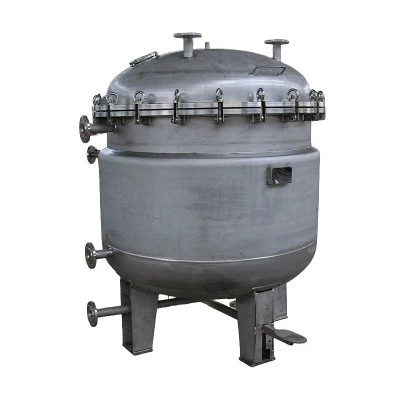
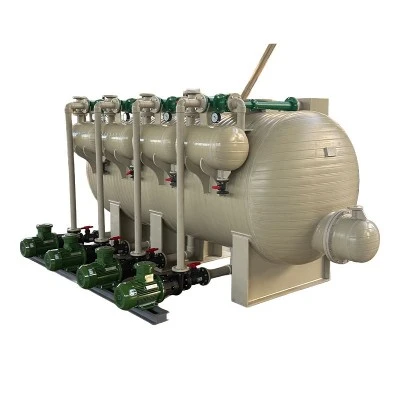


PPH Wound Vortex-Plate Tower
- Vortex plates generate centrifugal motion to improve gas-liquid contact and mass transfer
- One-piece PPH wound tower body with a seamless structure
- Absorption efficiency of over 98%
- Large plate opening ratio, high gas-liquid handling capacity, and low pressure drop
- Good resistance to clogging and straightforward maintenance
|
Parameter |
Details |
|
Tower body |
One-piece wound PPH construction with a seamless body and UV aging resistance. Resistant to many inorganic media and most organic solvents, with low scaling tendency. Suitable for dust-laden exhaust gas under compatible medium- and low-temperature conditions |
|
Vortex plate assembly |
Vortex plates arranged like fixed windmill blades inside the tower. Exhaust gas enters tangentially from the bottom, while absorption liquid is distributed from the top across the plate layers |
|
Working principle |
Gas flows upward from the bottom and rotates as it passes through the vortex plate blades. The absorption liquid forms fine droplets or a liquid film, increasing the contact area between gas and liquid. Inertial collision, centrifugal action, and liquid film contact promote absorption and particle removal. Liquid collected on the tower wall flows downward for further contact at lower plate levels |
|
Performance |
Absorption efficiency of over 98%; gas-liquid handling capacity stated to be more than twice that of conventional tower plates; low plate pressure drop, low system resistance, and good resistance to clogging |
|
Applications |
Pharmaceutical, chemical, metallurgy, electronics, electroplating, and coating industries. Suitable for treating acid mists containing sulfuric acid, nitric acid, and hydrochloric acid, as well as sulfur oxides (SOx), nitrogen oxides (NOx), dust, and paint mist, subject to the selected treatment process |
Exhaust gas enters tangentially at the bottom of the tower, while absorption liquid is distributed from the top across the vortex plate layers. As the gas rises through the blades, it develops a swirling flow that promotes contact between the gas and liquid. The liquid forms fine droplets or a film with a large contact area, improving mass transfer and the removal of soluble gas components and entrained particles.
The PPH Wound Vortex-Plate Tower uses inertial collision, centrifugal action, and liquid film contact to support gas absorption and dust removal. Centrifugal force drives droplets and particles toward the tower wall, where the collected liquid flows downward and continues to interact with the gas at lower plate levels. The tower design also helps separate liquid droplets from the gas stream, although the actual mist removal performance depends on operating conditions and the need for additional mist elimination equipment.
The vortex plates have a large opening ratio, allowing relatively high gas flow rates with a low pressure drop across the plates. The stated gas-liquid handling capacity is more than twice that of conventional tower plates. The design also offers good resistance to clogging and scaling, helping simplify routine cleaning and maintenance.
This equipment is used in pharmaceutical production, chemical processing, metallurgy, electronics, electroplating, and coating operations. Typical treatment targets include sulfuric acid mist, nitric acid mist, hydrochloric acid mist, sulfur oxides (SOx), nitrogen oxides (NOx), dust, and paint mist. The appropriate absorption liquid and tower configuration depend on the exhaust gas composition, flow rate, temperature, and treatment requirements.
The company has experience supplying waste gas purification equipment for coating and metallurgy plants. Each tower is customized according to the exhaust gas composition and flow rate, the type and concentration of the absorption liquid, and the required number of vortex plate layers and plate opening ratio.
The manufacturing process includes inspection of the PPH raw material, spiral winding of the tower body, component assembly, and commissioning. The final configuration is determined by the operating conditions and installation requirements.
Quality checks include absorption efficiency testing, system pressure drop testing, spray coverage testing, and inspection of resistance to clogging. Third-party inspection is accepted. The warranty period is one year.
The standard lead time is approximately two months, while customized orders generally require three months. EXW delivery terms apply. Products are wrapped in UV-resistant film and secured on pallets for transportation. Payments in USD and EUR are accepted.
Minimum order amount: RMB 50,000
Standard payment terms: 30% deposit, with the balance paid before delivery
Customized order payment terms: 50% deposit, with the balance paid before delivery
Please provide the exhaust gas composition, gas flow rate, absorption liquid type and concentration, and operating conditions so that the appropriate PPH Wound Vortex-Plate Tower configuration can be determined. Drawings or prototypes are welcome for reference during customization.
Hot Tags: pph wound vortex-plate tower, China pph wound vortex-plate tower manufacturers, suppliers, factory, Acid Resistant PPH Liquid Heat Exchanger, Corrosion Resistant PPH Resin Exchange Tank, Industrial Chemical PPH Winding Scrubber, Industrial PPH Winding Carbon Filter Tank, PPH Wound Vortex Plate Tower, Vertical PPH Winding Storage Tank
You Might Also Like


Send Inquiry