

Design principles of stainless steel demisters
Sep 15, 2026
Leave a message
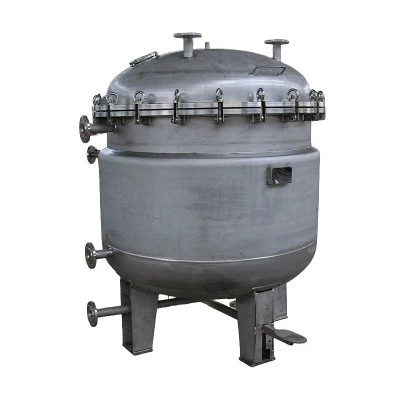
The design principle of stainless steel demisters mainly utilizes the inertial collision, direct interception, and coalescence of droplets during airflow to separate mist droplets entrained in the gas, thereby reducing the liquid content of the gas and minimizing the entry of droplets into subsequent pipelines or treatment equipment. In chemical, pharmaceutical, environmental protection, and industrial waste gas treatment systems, after gas undergoes spray absorption, washing, or cooling, it often carries a certain number of fine droplets. If not separated in time, this can lead to liquid accumulation in pipelines, equipment corrosion, or instability in subsequent process operation. Stainless steel demisters are typically installed near the gas outlet of absorption towers, spray towers, or other gas-liquid contact equipment. Depending on the treatment conditions, wire mesh or baffle plate structures can be used. Wire mesh demisters use a fine stainless steel wire mesh to capture droplets in the airflow. The droplets gradually gather and merge on the wire mesh surface, forming larger droplets that fall under gravity. Baffle plate demisters, on the other hand, use angled curved plates to change the direction of the airflow multiple times. Due to inertia, droplets cannot completely follow the airflow's direction, thus impacting the plates and adhering to the surface. After coalescence, they are discharged along the plates. The two structures operate differently, requiring careful selection based on factors such as droplet size, gas flow rate, operating temperature, and allowable pressure drop to achieve a reasonable balance between demisting efficiency and operating resistance.
For stainless steel demisters, key considerations include gas velocity, demister element structure, equipment dimensions, and drainage capacity. If the gas velocity is too low, some droplets may fail to effectively impact the demister element; if the velocity is too high, captured droplets may be re-introduced into the airflow, causing secondary entrainment. Therefore, designers need to determine a reasonable operating velocity based on the equipment's processing air volume and effective flow area, and select the wire mesh density, wire mesh thickness, or baffle spacing in conjunction with the target droplet size. For wire mesh demisters, the wire mesh pore structure, thickness, and support method must also be considered to avoid increased pressure loss or severe liquid accumulation due to excessive density. For baffle demisters, the baffle shape, turning angle, and drainage channel should be rationally designed to ensure that the airflow can effectively change direction while maintaining smooth liquid discharge. In terms of materials, 304 and 316L stainless steel are common choices, but the specific grade should be determined based on gas composition, droplet chemistry, chloride ion content, and operating temperature; it cannot be selected solely based on the corrosion resistance of stainless steel. For large demisters, sufficient support beams, fasteners, and maintenance space are also required to prevent structural deformation during long-term operation and facilitate subsequent disassembly and cleaning.
The design of stainless steel demisters should also consider equipment operational stability, maintenance convenience, and overall system compatibility. Since demisters are typically located inside gas-liquid contact equipment, they may be affected by solid particles, salt crystals, viscous substances, or corrosive droplets after long-term operation, causing localized blockages, poor drainage, or decreased demister efficiency. Therefore, during the design phase, the need for flushing devices, liquid collection structures, and maintenance accessories should be determined based on the characteristics of the medium, and a tight connection between the demister and the tower wall should be ensured to reduce the reduction in separation effect caused by gas flow around the demister. For gases containing large amounts of dust or easily scaled substances, pretreatment facilities should be installed before the demister if necessary to reduce the maintenance burden caused by contaminant deposition. After the equipment is put into use, it is necessary to regularly check whether the wire mesh is loose, whether the plates are deformed, whether the supporting components are corroded, and whether the drainage channel is unobstructed. Cleaning or maintenance should be arranged according to the operating pressure difference and the actual demisting effect. In general, the design of stainless steel demisters is not simply to add wire mesh or baffles, but requires a comprehensive design that combines airflow characteristics, droplet separation mechanism, material corrosion resistance, and on-site maintenance conditions. Only when the structure is reasonable, the airflow distribution is uniform, and the drainage is smooth can a stable demisting effect be achieved, thereby improving the operating efficiency of the entire waste gas treatment system.
Send Inquiry