

What is the maximum operating temperature for PPH wound ion exchangers?
Nov 11, 2026
Leave a message
If you’re in the industrial filtration, water treatment, or chemical processing space, chances are you’ve run into PPH wound ion exchangers—those spooled, porous resin-based workhorses that grab unwanted ions from liquids (and sometimes gases) without overcomplicating things. As a supplier of these units, I get asked one question more than any other: “What’s the maximum operating temperature I can run these at, without turning my expensive filter into a melted mess?” It’s not a trivial question; push a PPH wound ion exchanger too hard on heat, and you’ll get reduced filtration efficiency, cracked housings, or even full-on failure that costs downtime and cash. Let’s break this down like I’d chat with a customer who stopped by our booth at a trade show last month.
First, let’s level-set what a PPH wound ion exchanger actually is, because “PPH” isn’t just a random acronym. PPH stands for Polypropylene Homopolymer, a rigid, heat-resistant plastic that’s way more durable than the random plastic stuff you grab from a hardware store. Wound refers to how it’s made: we melt PPH resin into thin threads, wrap them around a porous core in a tight, spiral pattern, and infuse that structure with ion-exchange resins (think cation resins for removing heavy metals, anion resins for acid neutralization) tailored to your process.
The maximum operating temperature isn’t a one-size-fits-all number, though. It depends on three big factors: the quality of the PPH we use, how the ion-exchange resin is bonded to the PPH wound structure, and the chemicals the exchanger is handling. Let’s start with the PPH base material. Most standard PPH for wound filters has a continuous operating temp ceiling of around 80°C (176°F) and a short-term peak of 90°C (194°F)—that’s the baseline for most units we ship out. But here’s the catch: not all PPH is equal. Cheaper PPH (we won’t name names) might have additives that break down at higher temps, so their max is more like 70°C (158°F), no peak allowed. We only use virgin PPH, no recycled scraps, because recycled PPH has inconsistent molecular structure that weakens under heat. That’s why our PPH wound ion exchangers hold up better in high-temp runs than the off-brand ones you might see on Alibaba.
Then there’s the ion-exchange resin part. Even if the PPH can handle 80°C, the resin might not. Most standard cation and anion resins start to degrade around 60°C (140°F)—if you push the fluid going through the exchanger past that, the resin’s tiny ion-exchange sites crack off, and suddenly your exchanger can’t do its job. For customers running really hot processes (like hot water treatment or food and beverage pasteurization side streams), we offer a modified version where the resin is cross-linked with a heat-stabilized polymer that bumps the resin’s max up to 75°C (167°F). That’s a sweet spot we worked on with our lab team last year, and it’s been a game-changer for a few food plants we’ve supplied.
Wait, but what about short-term spikes? Like, if you have a 15-minute blast of 85°C fluid during a process flush, is that okay? For our standard units, yeah, but don’t make a habit of it. Every time you push past the continuous temp limit, you’re slowly breaking down the PPH threads—over a year, that 15-minute spike adds up to more stress than running steady at 80°C, and you’ll get a leak or a clogged filter way sooner than expected. We always tell customers to design their systems to stay within the continuous temp range, and only use short peaks for maintenance, not regular operation.
Let’s tie this to real-world use cases to make it less abstract. Last quarter, a chemical plant called us because their old PPH wound ion exchanger kept failing—they were running their brine processing at 82°C, which was above the manufacturer’s max. They tried rerunning at 78°C, but their throughput dropped 20%, so they came to us for a fix. We swapped in our modified high-temp resin units and adjusted their system’s flow rate to keep the fluid at 76°C, and now they’re hitting their throughput without any failures. That’s the kind of problem we solve every day, not just selling a filter and forgetting about it.
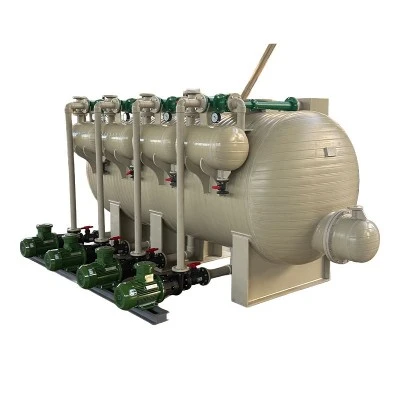
Now, let’s talk about related products we offer, because a lot of customers who need ion exchangers also need other PPH wound equipment. If you’re running that same high-temp chemical process, you might not just need an ion exchanger—you’ll need a duct to move hot air or fumes around, right? We make a PPH Anti Static Wound Duct that works up to 90°C, perfect for exhausting fumes from that brine processing line. Or if you’re storing the process fluid before it hits the exchanger, our PPH Wound Horizontal Storage Tank has a max operating temp of 85°C, so you don’t have to worry about the tank warping while holding hot fluid. For purification towers that feed into your ion exchangers, we have both Anti Static PPH Wound Purification Tower and standard PPH Wound Purification Tower options, depending on if you’re handling explosive fumes or just regular water. We also build Wound PPH Reaction Tank for customers who need to mix chemicals before they go through the ion exchange step. It’s all part of building a cohesive system that works for your temp and chemical needs, not just picking one piece of equipment.
Wait, I should also clear up a common myth: some people think that because PPH is plastic, it’s not good for high temps. That’s not true—PPH holds up way better than PVC or polyethylene (PE) at temps above 60°C. PE, for example, softens around 70°C, so if you use a PE-based wound exchanger, you’re asking for trouble. PPH’s melting point is around 160°C (320°F), so we’re never close to that in normal operation, but the molecular bonds start to weaken above 80°C, which is why we cap the operating temp where we do.


Another thing: pH level plays a role too. If your process fluid is super acidic (pH <2) or super alkaline (pH >12), that can lower the max operating temp even if it’s within the 70-80°C range. Acid eats away at the PPH’s molecular structure, so in corrosive environments, you need to drop the operating temp by 5-10°C to keep the exchanger from degrading fast. We always ask customers to share their process specs (pH, chemical composition, temp, flow rate) before we quote, because one size never fits all.
Let’s wrap this up with practical advice, since no one cares about numbers if they can’t apply them. If you’re choosing a PPH wound ion exchanger:
- Check the base PPH material—virgin is non-negotiable for consistent temp resistance.
- Ask about the ion-exchange resin’s heat rating, not just the PPH’s.
- Stick to 70-80°C continuous for standard units, 75°C max for high-temp resin models.
- Short peaks are fine, but don’t make them regular.
And if you’re not sure what your process can handle? That’s what we’re here for. We don’t just sell filters—we help you spec the right unit for your specific setup, whether you’re a small brewery needing water purification or a big chemical plant processing industrial waste. We’ve been in this space for years, and we’ve worked out kinks for all kinds of industries.
So if you’re tired of ion exchangers failing at high temps, or you’re putting together a full PPH wound system for your process, hit us up for a consultation. We can walk through your needs, share specs, and make sure you get equipment that works as hard as you do.
References
- "Polypropylene Homopolymer (PPH) Properties for Industrial Applications", International Plastic Fabricators Association, 2022
- "Ion Exchange Resin Thermal Stability Guidelines", Water Quality Association, 2021
- "Wound Filter Media Performance Under High-Temp Chemical Conditions", Journal of Industrial Filtration, 2023
- "PPH Wound Equipment Operating Temperature Ranges", Process Engineering Journal, 2022
Send Inquiry